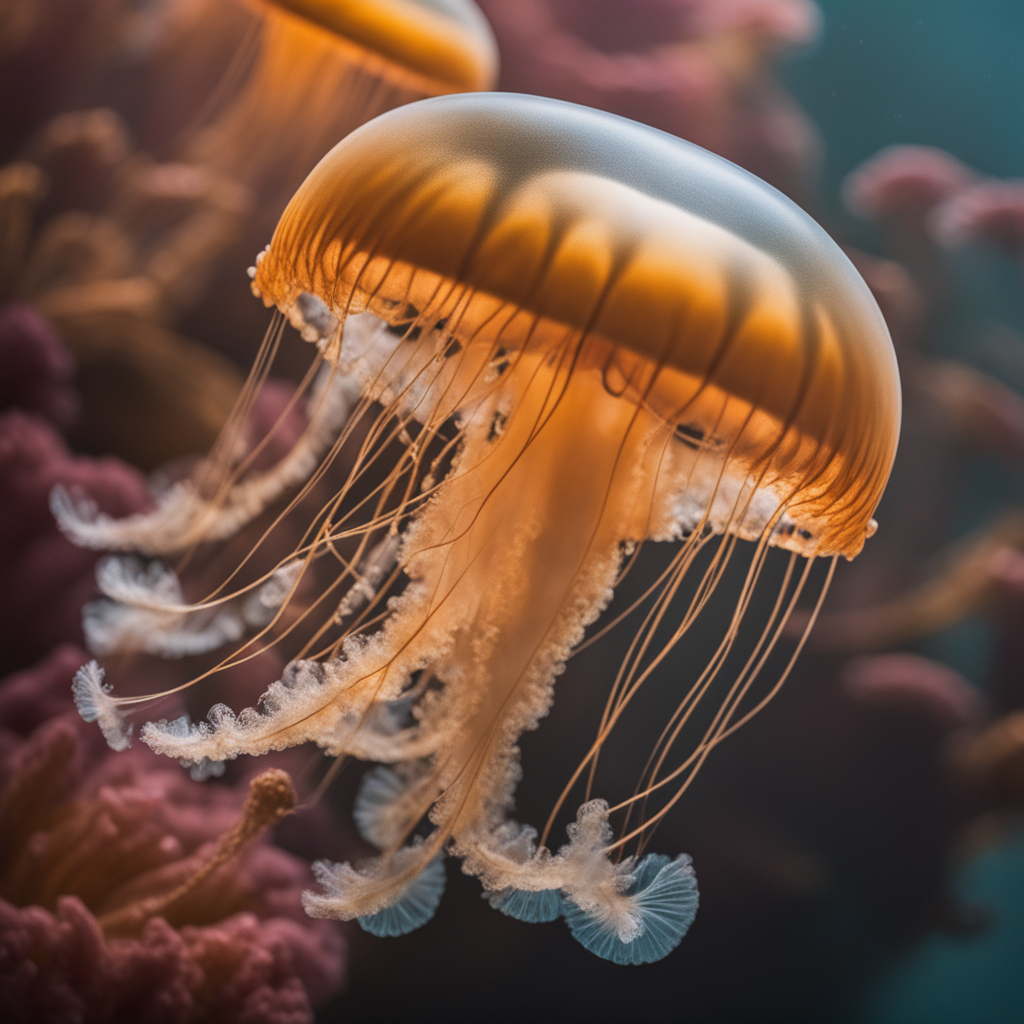
Floating through the salt-heavy depths like living lace, jellyfish appear more like misplaced fragments of a dream than biological entities. They possess no hearts, no bones, and no centralized brains, yet they have danced through the planetary oceans for over 500 million years. This endurance is no fluke of luck. It is the result of a reproductive strategy so complex and alien that it borders on the supernatural. To understand how these gelatinous drifters populate our seas is to witness a masterclass in evolutionary survival, a rhythmic cycle of transformation that shifts from microscopic hitchhikers to the pulsating umbrellas we recognize on the horizon.
The Dance of the Medusa: A Broadcast in the Blue
The story begins with the medusa, the adult stage of the jellyfish life cycle. In the vast, echoing chambers of the open ocean, finding a mate is not a matter of proximity or courtship. Instead, it is an act of faith. Most jellyfish species are either male or female, and they engage in what biologists call broadcast spawning.
When the environmental cues are just right—perhaps a shift in water temperature or the subtle pull of a full moon—the medusa release clouds of eggs and sperm directly into the water column. It is a chaotic, shimmering lottery. In the churning currents, fertilization happens by chance. This external meeting of genetic material creates a tiny, vibrating larva known as a planula. This minute traveler, covered in microscopic hairs called cilia, spins through the water like a tumbling star, seeking a place to call home.
From Drifter to Dweller: The Polyp Phase
The planula does not stay a nomad for long. It eventually descends from the sunlit surface to the dark, silent floors of the ocean or the rough undersides of rocky ledges. Here, the creature undergoes its first radical metamorphosis. It attaches itself to a hard surface and grows into a polyp.
At this stage, the jellyfish looks less like a bell and more like a tiny sea anemone. It is a stationary hunter, extending stinging tentacles to catch passing plankton. What makes the polyp stage truly remarkable is its ability to clone itself. Through a process of budding, a single polyp can create an entire colony of identical twins, carpeting the seafloor in a quiet, hidden army. This phase can last for months or even years, waiting for the perfect moment to trigger the next great leap forward.
The Great Stacking: Strobilation and the Birth of Ephyrae
When the sea whispers that the time is right, the polyp undergoes a bizarre physical transformation called strobilation. The body of the polyp begins to develop horizontal grooves, looking much like a stack of translucent dinner plates or a pile of microscopic pancakes.
Each “plate” in this stack is a future jellyfish. One by one, these segments pulse, break free, and begin to swim. These tiny, notched infants are called ephyrae. They do not yet have the smooth, rounded bells of their parents. Instead, they look like fragile, eight-pointed stars flickering in the current. As they feed on nutrient-rich microscopic organisms, their bodies fill out, their bells harden, and they grow into the majestic medusae that haunt the tides.
The Immortal Exception: Defying the Cycle
While most jellyfish follow this linear path from egg to polyp to medusa, some species have learned to cheat the reaper. The Turritopsis dohrnii, often dubbed the immortal jellyfish, has mastered a trick of biological time travel. If this creature faces starvation, physical injury, or environmental stress, it does not simply die.
Instead, it undergoes transdifferentiation. Its cells transform back into their earliest states, and the adult medusa reverts into a polyp, starting the entire life cycle over again. It is a poetic loop, a refusal to exit the stage, ensuring that the dance of the jellyfish continues across the eons without end.
The Rhythm of the Tides
Understanding how jellyfish reproduce is not merely a lesson in marine biology. It is a glimpse into a world that operates on a different clock. Their life cycle is a symphony of shifts—from mobile to sessile, from sexual to asexual, from solitary to colonial. They are the ultimate survivors, turning the simple act of existing into an intricate, multi-generational performance that blankets the world’s oceans in ghostly beauty.
Leave a Reply
You must be logged in to post a comment.